Teaching Framework

AURA-Learn

Agentic Understanding, Reflection and Adaptation for Learning — an AI-supported educational framework that personalises learning while strengthening the role of the teacher.

🧑‍🎓 Student Agent 👩‍🏫 Teacher Agent 📊 Evaluator Agent
🎯

Central Idea

Not to replace the teacher, but to create an intelligent learning environment where each student receives adaptive support and teachers gain meaningful pedagogical insight.

🔄

Continuous Feedback

Three interconnected agents create a closed feedback loop: individual learning informs group-level teaching, which feeds course-level evaluation and continuous improvement.

🌍

Environmental Focus

Designed for water and environmental science education, covering watershed analysis, hydraulics, water quality, climate impacts, modelling, and policy decision-making.

The Complete Learning System

How professors, AI agents, and students collaborate in a dynamic, feedback-driven educational environment for water resources learning.
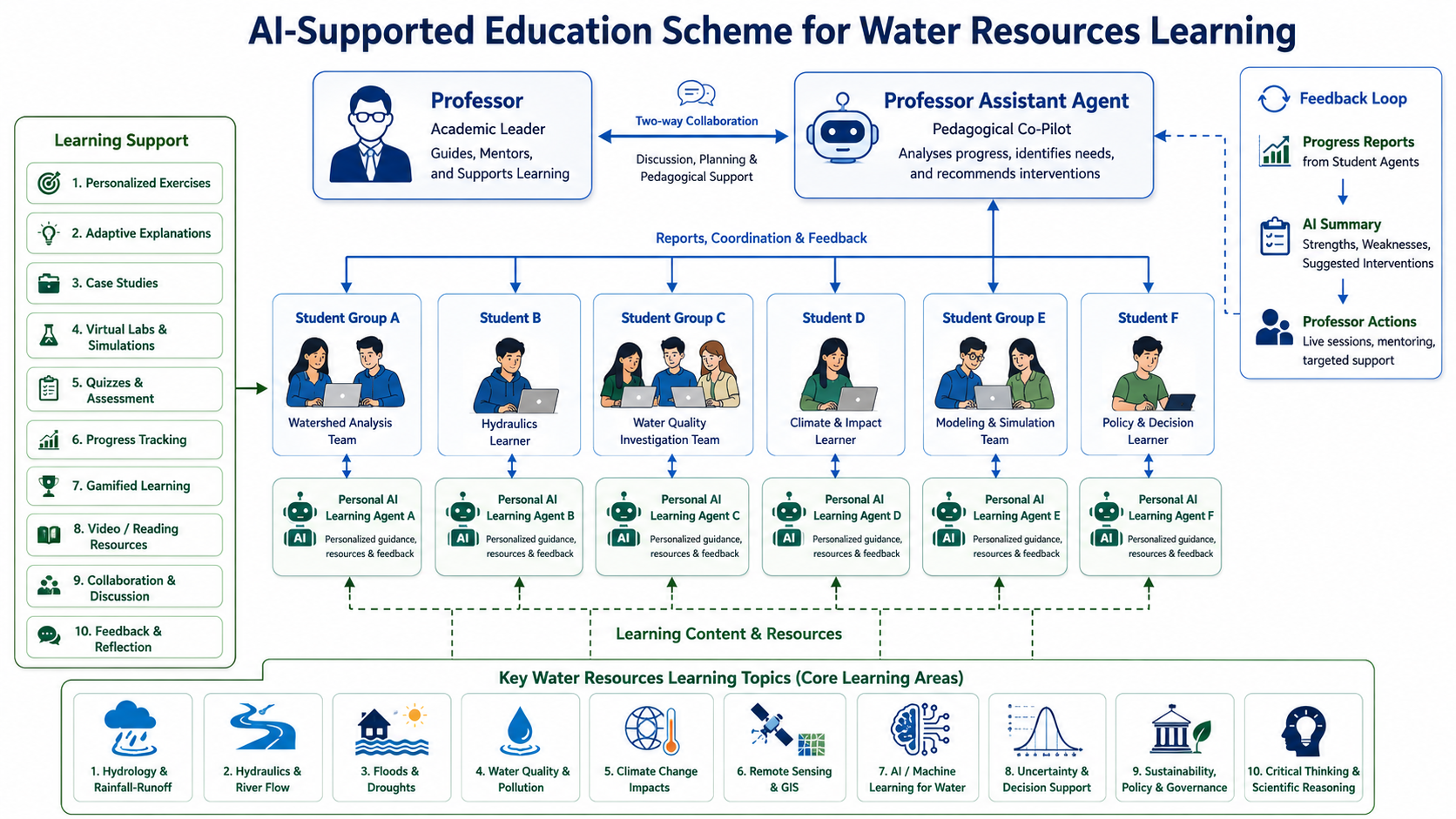
AURA-Learn AI-Supported Education Scheme — full architecture diagram
View full size

AI-Supported Education Scheme for Water Resources Learning · Ai-LEARN Consortium, 2025

Key System Components

Professor Academic leader — guides, mentors, and supports learning. Sets the pedagogical direction and remains the human authority throughout the course.
Professor Assistant Agent Pedagogical co-pilot. Synthesises all student-agent reports, identifies group patterns, and surfaces targeted teaching recommendations.
Student Agents (A–F) Each student has a personalised AI guide handling their specific topic — from watershed analysis and hydraulics to policy and decision-making.
Learning Content & Resources Adaptive exercises, case studies, virtual labs, simulations, video resources, and structured reflection activities — all personalised per student.
Feedback Loop

Student agent reports flow back to the Professor Assistant Agent, which generates an AI summary and targeted suggestions — closing the learning loop continuously.

Core Topics
Hydrology & Runoff Sustainability Floods & Droughts Water Quality Climate Impacts Remote Sensing Decision Support Policy & Economics
AURA-Learn Framework — Full Size

AI-Supported Education Scheme for Water Resources Learning · Ai-LEARN Consortium, 2025

Roles & Responsibilities

Each agent operates at a different level of the system, creating a coherent and self-improving pedagogical architecture.

🧑‍🎓
Individual Level

Student Agent

A personal AI learning guide for each student. Provides exercises, examples, explanations, games, and videos adapted to learning style, progress, and difficulties. Follows the full learning cycle.

  • Adapts to individual learning style and pace
  • Follows the full structured learning cycle
  • Produces daily reflections and progress summaries
  • Recommends next steps and areas for review
Student Agent in detail →
👩‍🏫
Group Level

Teacher Agent

A pedagogical assistant for the lecturer. Synthesises progress reports from all student agents, identifies group-level patterns — strengths, misconceptions, pacing — and prepares targeted teaching guidance.

  • Aggregates all student-level reports
  • Identifies group-wide patterns and gaps
  • Suggests questions and discussion points
  • Flags students who may need extra support
Teacher Agent in detail →
📊
Course Level

Evaluator Agent

An independent course observer. Monitors knowledge development before and after the course, compares expected outcomes with actual progress, and builds a long-term evidence base to improve future editions.

  • Pre/post knowledge assessments
  • Compares expected vs. actual learning gains
  • Identifies most effective teaching strategies
  • Feeds a longitudinal evidence database
Evaluator Agent in detail →
🧑‍🎓

The Student Learning Agent

Individual Level · Personalised Guidance

Acts as a personalised tutor and learning companion — it does not simply answer questions. It follows the learning process and helps the student build understanding progressively.

Each student has an individual AI guide. If a student struggles with a mathematical concept, the agent first provides an intuitive explanation, then a visual example, then a guided exercise, and finally a question that checks independent application. The agent adapts based on what has been tried and what has worked.

The Student Agent's role is to:

  • Provide exercises, examples, links, games, videos, and explanations tailored to the student's level
  • Adapt explanations to the student's learning style and identified difficulties
  • Suggest material for repetition or deeper exploration based on progress patterns
  • Identify individual strengths and weaknesses throughout the course
  • Guide the student through daily learning phases from introduction to application
  • Prepare short daily reflections summarising progress, gaps, and recommended next steps
  • Recommend what the student should continue, repeat, or raise with the teacher
👩‍🏫

The Teacher Agent

Group Level · Pedagogical Intelligence

Transforms individual student reports into actionable pedagogical intelligence. It identifies patterns that would otherwise be difficult to detect in a large or diverse class.

The teacher agent helps the lecturer answer questions that would otherwise require reviewing dozens of individual reports.

  • Which topics are students understanding well, and which are creating persistent confusion?
  • Which types of explanations have already been tried — and which have helped most?
  • Which students may need additional support or a different approach?
  • Is the group progressing at the expected pace, or does the plan need adjustment?
  • Should the next session include review, practice, open discussion, or new material?
  • Are additional face-to-face sessions needed, and on which specific topics?
The teacher agent does not decide for the teacher — it helps the teacher see patterns, prepare well, and make informed decisions. The human teacher remains the pedagogical authority.
🏫

Face-to-Face Learning Sessions

During planned in-person or synchronous sessions, the teacher remains the main driver of the learning process. AURA-Learn enriches — not replaces — these sessions.

Before a session, the teacher agent may indicate that several students understand the definition of a concept but struggle to apply it in a real case. It may suggest opening the session with a practical example, asking students to explain their reasoning aloud, then providing a complementary explanation bridging theory and application.

In this way, the AI system enriches the teacher's work. It creates space for student questions, peer discussion, and teacher-led clarification. The human teacher remains responsible for judgment, motivation, interpretation, and the final pedagogical direction. The agent provides intelligence; the teacher provides wisdom.

📊

The Independent Evaluator Agent

Course Level · Longitudinal Evidence

Follows the entire course from a neutral, longitudinal perspective — observing reports from the student agents, the teacher agent, and course development across time and cohorts.

This component transforms the course into a self-improving learning system. Each new edition benefits from the accumulated evidence of previous editions.

  • Evaluate knowledge before and after the course using structured pre/post assessments
  • Monitor learning progression across days or weeks, identifying acceleration and plateaus
  • Identify which teaching strategies were most effective for which student profiles
  • Compare expected learning outcomes with actual measured progress
  • Detect gaps between individual student learning and group-level outcomes
  • Provide recommendations for future editions of the course
  • Contribute to a long-term database of learning evidence across cohorts

The Daily Learning Cycle

AURA-Learn operates through a structured six-phase daily cycle, with each agent responsible for specific phases of the process.

1
Student Agent

Learning Activity

Student works with exercises, examples, videos, games, or explanations adapted to their current level and learning style.

2
Student Agent

Reflection

Agent identifies strengths, weaknesses, misconceptions, and areas to revisit or explore more deeply.

3
Student Agent

Reporting

Student progress is summarised in a structured report and sent to the teacher agent for group-level synthesis.

4
Teacher Agent

Pedagogical Synthesis

Teacher agent analyses all student reports, identifies group-level patterns, and generates teaching recommendations.

5
Teacher + Teacher Agent

Teaching Adaptation

Lecturer reviews recommendations, adjusts examples, pace, or support sessions, and prepares the next interaction.

6
Evaluator Agent

Evaluation

Independent evaluator monitors progression, compares against expected outcomes, and updates the long-term learning evidence database.

AURA-Learn in Full

"

AURA-Learn — Agentic Understanding, Reflection and Adaptation for Learning — is an AI-supported educational framework designed to personalise learning while strengthening the role of the teacher. Each student is supported by an AI learning guide that provides exercises, examples, links, games, videos, and explanations adapted to the student's learning style and progress.

These reports are shared with a teacher agent, which synthesises the progress of the group, identifies common difficulties, suggests examples and questions, and helps the lecturer decide whether the course pace is appropriate or whether additional support is needed. During face-to-face sessions, the teacher agent assists the lecturer in preparing targeted discussions, while the teacher remains the main driver of the learning process.

An independent evaluator agent follows the course development, compares knowledge before and after the training, and contributes to a growing database of learning evidence. In this way, AURA-Learn creates a progressive learning system in which students receive personalised guidance, teachers receive pedagogical intelligence, and future courses improve through accumulated knowledge.

— Ai-LEARN Consortium, 2025

Three-Agent Pedagogical Architecture

Together, the three agents create a continuous feedback loop between learning, teaching, and evaluation.

🧑‍🎓
Individual

Student Agent

Personalised guidance, exercises, feedback, and daily learning reflection. Works at the individual level, adapting in real time to each student's trajectory.

👩‍🏫
Group

Teacher Agent

Synthesis of student progress, teaching recommendations, and support for face-to-face sessions. Works at the group level, informing the lecturer's pedagogical decisions.

📊
Course

Evaluator Agent

Independent monitoring of course development, knowledge gain, and long-term improvement. Works at the course level, feeding insights across cohorts and editions.